Live Roulette and Televised Football Share a Need for Flicker-Free Lighting
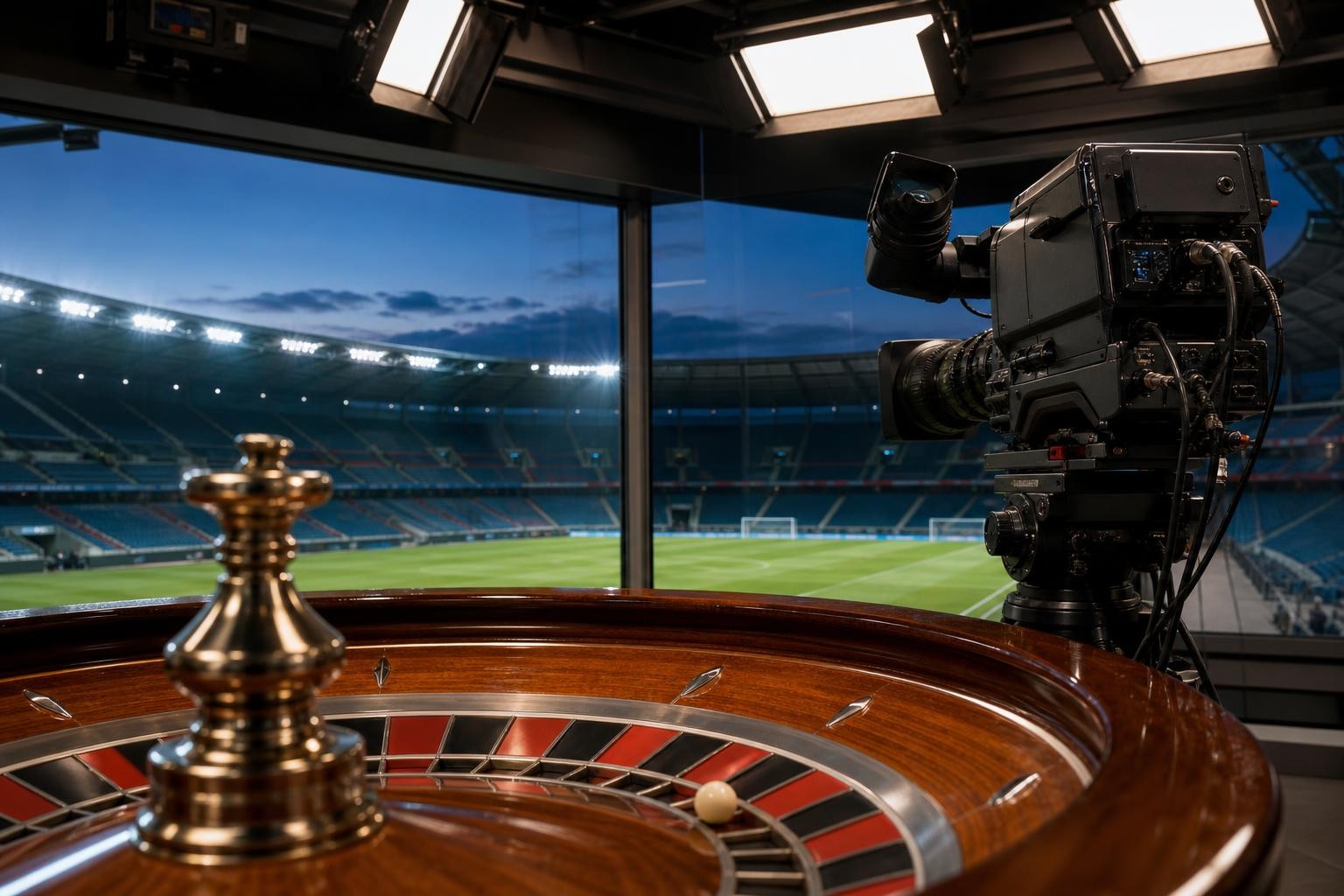
Watch a football replay closely and a disputed touch can become easier to follow. The ball brushes a boot, changes direction and passes the goalkeeper. Slowing the footage gives viewers time to see each movement, provided the camera has captured clear, evenly lit images.
That last detail depends partly on the floodlights. Their brightness must hold steady through the camera’s exposures. The same concern appears on a smaller scale in live roulette studios, where close-up cameras follow a ball around a wheel and record its final movements for replay.
Following the Ball From Pitch to Wheel
Football directors cut between the whole pitch, individual players and close-ups of the action. Live roulette uses a comparable mix of views: the presenter, the table and the ball moving around the wheel.
For Ontario viewers, broadcasts available through pages such as
live roulette ontario arrive with much of the production work outside the frame. Cameras, microphones, lighting and video equipment surround the table, with staff coordinating what reaches the screen.
A roulette format launched in late 2013 shows how far this approach had developed. Its production used multiple HD cameras and was documented at 200 frames per second. That means an image every five milliseconds, giving the replay a succession of views as the ball settles. Automatic camera sequences also changed the presentation between spins.
Ontario online casino gambling is restricted to adults aged 19 and older. Anyone concerned about their gambling can contact ConnexOntario for confidential support.
What the Camera Sees in the Light
Recording that many images makes the behaviour of the lighting important. Electric lights can change brightness rapidly, with variations that a camera picks up even when the room looks steadily illuminated to someone standing in it.
The result may be a pulsing picture or bands moving across the image. How it appears depends on the light and the camera settings.
Capture rate is the number of images recorded each second. Shutter speed is the length of time each image receives light. When those exposures catch different parts of a light’s brightness cycle, the recorded illumination can vary.
The
US Department of Energy explains that LED output depends heavily on the driver, the electronics supplying power to the light. Its design, along with compatibility with dimming equipment, affects how consistently the LED produces light.
Lighting manufacturer ETC offers a specific example of camera-oriented control. Certain fixtures have a 25-kilohertz setting, equivalent to 25,000 cycles per second, to help address flicker or rolling bars.
Camera adjustments matter too. Sony’s guidance describes matching shutter speed to the flickering cycle and recommends recording a test to check the result.
Stamford Bridge’s Floodlights Had Two Jobs
At football grounds, these requirements influence decisions about equipment mounted high above the stands. Stamford Bridge provides a clear example from August 2014, when Philips announced the installation of its ArenaVision LED floodlights.
Replacing the previous metal-halide system, the new lights were explicitly linked to high-definition, flicker-free super-slow-motion pictures in the
installation announcement. They could also switch on immediately, and each floodlight could be controlled individually.
Those controls gave the stadium another use for its pitch lighting. Lighting designer Tim Routledge worked with Philips and Chelsea on programmed light shows, with Tom Young handling lighting programming.
The system used DMX, a method of sending instructions to lighting fixtures. It allowed coordinated sequences for the entertainment before and after matches, alongside the illumination needed during play.
For a supporter in the stands, the most noticeable change might be the light show. At home, the benefit could appear in a replay. Both came from decisions about the same installation, serving the match and its presentation.
Lighting the Table and the Room Around It
A roulette studio brings the cameras and lighting much closer to the subject. Crews manage the picture as it changes from a presenter’s face to the wheel, while sound and broadcast staff keep the production running.
Around that filmed action, decorative lights establish the room’s appearance. Studio builders have described colour-changing LEDs in steps, recessed lighting around roulette wheels and lightboxes behind the table. The layout of these features forms part of the set design.
Such broadcasts also have established production bases in North America. A 16,000-square-foot studio in New Westminster, British Columbia, was announced as operational in February 2018, complete with a dedicated data centre. An Atlantic City studio followed that August with 10 online live tables.
Whether the camera faces a football pitch or a roulette wheel, the small movements viewers examine depend on work done before recording begins: choosing the lights, setting the exposure and checking the picture.
